
Water Mitigation in
Fort Worth, TX
Rapid emergency water mitigation to stop damage progression — extraction, containment, and structural drying within hours of a water event in Fort Worth and Azle. Available 24/7 for residential and commercial properties.
Comprehensive Water Mitigation
Water mitigation is the emergency phase of the restoration process: the first hours after a water event where fast action prevents minor damage from becoming catastrophic. Our mitigation crews extract standing water, document conditions for insurance, set containment where needed, and deploy commercial drying equipment within hours of your call. Every hour of delay allows water to penetrate deeper into walls, floors, and structural cavities — mitigation speed directly determines restoration cost.
Water mitigation and water damage restoration are often used interchangeably, but they represent two distinct phases of the same process. Mitigation is the emergency response: the rapid actions taken in the first hours and days after a water event to stop damage from progressing. Restoration is the reconstruction phase: replacing drywall, flooring, and finishes after the structure has been fully dried. The quality of mitigation work directly determines how much restoration work will be needed — and how much your claim will cost.
The science behind water mitigation is psychrometrics — the study of air's moisture-carrying capacity. When water enters a building, it immediately begins transferring from wet building materials into the surrounding air. But uncontrolled, this process is slow and uneven: air in a closed room quickly approaches saturation, stalling further evaporation, and moisture redistributes from wet areas to adjacent dry areas through diffusion. Commercial drying equipment — high-velocity air movers and low-grain refrigerant (LGR) dehumidifiers — dramatically accelerates this process by continuously replacing saturated air near wet surfaces with dry air that has high capacity to carry additional moisture vapor, then condensing that vapor out of the airstream before it can redistribute into the structure.
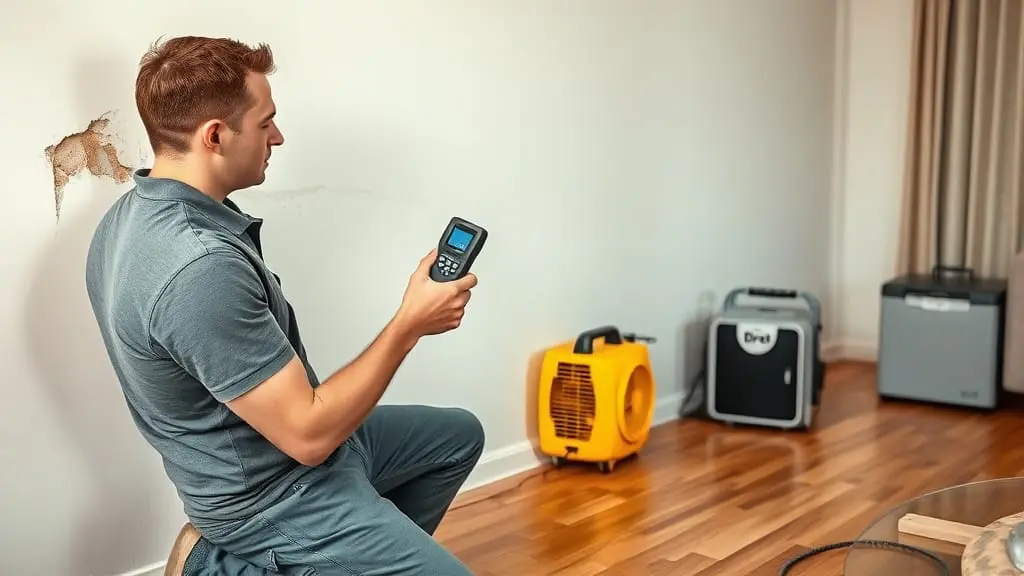
Our mitigation process begins with a complete moisture map of the affected area. Using thermal imaging cameras and calibrated pin-type and pinless moisture meters, we measure moisture content in every wall cavity, floor assembly, and ceiling affected by the water event. This documentation serves two purposes: it guides equipment placement to maximize drying efficiency, and it creates the evidentiary record required by insurance adjusters to approve the drying scope. We photograph all readings and upload them to a moisture tracking log that shows drying progress across successive daily checks.
Water category classification — clean water (Category 1), gray water (Category 2), or black water (Category 3) — determines the sanitation protocol. A Category 1 event from a clean supply pipe requires extraction and drying. A Category 2 event from a washing machine overflow or dishwasher failure requires antimicrobial treatment of all contacted materials. A Category 3 event involving sewage, groundwater, or floodwater requires more aggressive treatment and removal of porous materials that cannot be adequately decontaminated. Misclassifying water category is one of the most common errors in the restoration industry — we train our crews to correctly identify water source and apply the appropriate IICRC S500-compliant protocol.
Common Causes in Fort Worth
- Burst pipes from freeze events or high pressure
- Appliance supply line failures (dishwasher, washing machine, refrigerator)
- Storm flooding through doors, windows, or foundation
- Roof leaks during heavy North Texas rainfall
- Sewer backups into lower-level drains
- HVAC condensate overflow from clogged drain lines
Our Restoration Process
Assessment & Inspection
We identify the source of water and map the moisture spread.
Water Extraction
Removing standing water immediately to prevent secondary damage.
Drying & Dehumidification
Industrial equipment dries deep into walls and floors.
Cleaning & Sanitizing
We use antimicrobial treatments to ensure safety.
Frequently Asked Questions
What is the difference between water mitigation and water damage restoration?
Mitigation is the emergency phase: stopping ongoing damage, extracting water, and drying the structure to prevent further deterioration. Restoration is the rebuild phase: replacing damaged drywall, flooring, and finishes after the structure is dry. Both are required after most water events. We handle both under one roof, which streamlines your insurance claim and eliminates the coordination gap between separate mitigation and reconstruction contractors.
How quickly can you respond to a water mitigation call in Fort Worth or Azle?
We dispatch a certified technician within 60 minutes for calls in our primary service area, which includes Azle, Fort Worth, and surrounding Tarrant and Parker County communities. We operate 24 hours a day, 7 days a week, including holidays. Every hour of delay allows water to penetrate deeper into walls and flooring — call us at (817) 607-3264 immediately when you discover water damage.
Does insurance cover water mitigation costs?
Yes — mitigation costs are typically the first costs your insurer approves after a covered water damage event. Most policies require you to take reasonable steps to mitigate further damage after a covered loss. We handle all documentation, scope writing, and adjuster coordination, and we bill your insurance directly. Most homeowners pay only their deductible.
Water Mitigation Near You
We serve the entire Fort Worth metro area. Click your city for local pricing, response times, and area-specific information.
Get Priority Response
Step 1 of 3Service Details
- Truck-mount and portable extraction units
- LGR (low-grain refrigerant) commercial dehumidifiers
- High-velocity axial and centrifugal air movers
- Thermal imaging cameras for moisture mapping
- Calibrated pin-type and pinless moisture meters
- Negative air machines for containment zones
Why Choose Us?
- Locally Owned & Operated
- Direct Insurance Billing
- 5-Star Google Rated