
What Equipment Do Water Damage Restoration Companies Use?
What Equipment Do Water Damage Restoration Companies Use?
When 2 Brothers Restoration arrives at a water-damaged home in Fort Worth, we bring a trailer full of specialized equipment that most homeowners have never seen before. This is not your household shop vac and box fan. Professional water damage restoration requires industrial-grade tools engineered to extract water, dry structures, detect hidden moisture, and ensure indoor air quality. Understanding what these tools do and why they matter helps you appreciate why professional restoration produces dramatically better results than DIY efforts.
Water Extraction Equipment
The first priority in any water damage event is removing standing water as quickly as possible. Every minute that water sits on your floors, it is being absorbed deeper into structural materials. Our extraction equipment is designed for speed and thoroughness.
Truck-Mounted Extractors
Our primary extraction tool is a truck-mounted unit powered by a gasoline engine that generates significantly more suction than any portable unit. These systems can extract thousands of gallons per hour and are connected to the building via long hose runs. The truck-mounted design means the noise stays outside your home, and the extracted water is stored in a large holding tank on the vehicle rather than requiring constant emptying.
Portable Extractors
For areas that hose runs cannot reach, such as upper floors, tight crawlspaces, or interior rooms far from an exterior wall, we use commercial portable extractors. These units are wheeled into position and provide powerful suction for localized extraction. They are especially useful for extracting water from carpet and padding.
Weighted Extraction Tools
Hard surfaces like hardwood floors, tile, and concrete require a different approach. We use weighted extraction wands that press down onto the surface to create a seal, then apply vacuum pressure to pull water up through grout lines, between floorboards, or from pores in the concrete. This technique is critical for saving hardwood floors.
Submersible Pumps
When dealing with significant standing water, such as a flooded basement or a flood damage cleanup after a major storm, we deploy submersible pumps that sit directly in the water and can move hundreds of gallons per minute to exterior drains or holding containers.
Drying Equipment
After extraction removes the bulk water, the real work of structural drying begins. This is where the most sophisticated equipment comes into play.
Axial Air Movers
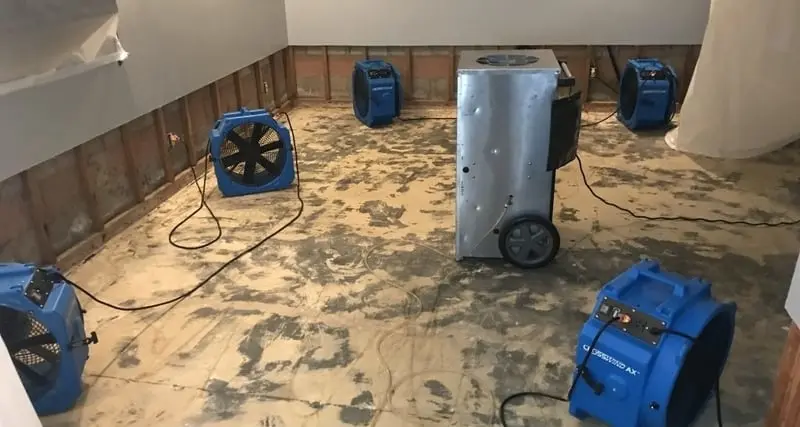
These are the most recognizable pieces of restoration equipment, the compact, powerful fans you see lined up along walls and across floors during a drying job. Axial air movers create high-velocity airflow across wet surfaces, dramatically accelerating the evaporation of moisture from building materials. A typical residential water damage job requires 10 to 20 air movers, and we position each one at specific angles calculated to maximize airflow coverage.
Centrifugal Air Movers
Where axial movers provide broad airflow, centrifugal air movers deliver focused, high-pressure streams of air. We use these in tight spaces like wall cavities, under cabinets, and in areas where we need to direct airflow into a specific target zone.
Low-Grain Refrigerant (LGR) Dehumidifiers
These are the workhorses of the drying process. LGR dehumidifiers pull moisture out of the air and drain it away via a hose to a sink or exterior outlet. A single commercial LGR unit can remove 15 to 30 gallons of water from the air per day. The "low-grain refrigerant" technology means these units continue to perform efficiently even when the air's moisture content drops to low levels, which is essential for achieving thorough drying of dense materials.
Desiccant Dehumidifiers
For extreme drying situations, such as deeply saturated concrete slabs or large commercial spaces, we deploy desiccant dehumidifiers. These units use a chemical drying agent (desiccant wheel) to strip moisture from the air to very low humidity levels, well below what refrigerant units can achieve. Desiccant systems can dry materials that would take weeks with conventional equipment in a matter of days.
Wall Cavity Drying Systems
When moisture is trapped behind drywall inside wall cavities, we use specialized panels or injection ports to force warm, dry air directly into the cavity. These systems dry the wall framing and insulation without requiring demolition of the drywall, saving significant reconstruction costs when conditions are right.
Hardwood Floor Drying Mats
These specialized mat systems sit directly on top of hardwood flooring and create a controlled vacuum that draws moisture upward through the wood. This is far more effective and gentler than blowing air across the surface, which can cause uneven drying and permanent warping.
Moisture Detection Equipment
You cannot manage what you cannot measure. Our detection equipment allows us to find hidden moisture, map its extent, and track drying progress with precision.
Infrared Thermal Imaging Cameras
Thermal cameras detect temperature differences on surfaces. Wet areas are cooler than dry areas due to evaporative cooling, so moisture shows up clearly on the thermal image even when it is hidden behind walls or under flooring. We use thermal imaging during the initial assessment and throughout the drying process to verify progress.
Pin-Type Moisture Meters
These meters use two small pins inserted into the material surface to measure electrical resistance, which correlates directly with moisture content. Pin meters provide precise readings at specific depths and are our primary tool for tracking drying progress in wood, drywall, and other building materials.
Pinless Moisture Meters
For surfaces where pin holes are undesirable, such as finished hardwood floors or decorative paneling, pinless meters use electromagnetic signals to detect moisture without penetrating the surface. These are excellent for quick scanning of large areas.
Thermo-Hygrometers
These instruments measure temperature and relative humidity simultaneously, allowing us to calculate the specific humidity and dew point of the drying environment. These readings are essential for optimizing equipment placement and ensuring the drying environment is performing as designed.
Air Quality and Containment Equipment
Water damage often involves contaminants, and the drying process itself can release particles and odors into the air. We use specialized equipment to maintain air quality throughout the project.
HEPA Air Scrubbers
These units draw air through a series of filters, culminating in a HEPA filter that captures 99.97 percent of particles down to 0.3 microns. This includes mold spores, dust, and other airborne contaminants. Air scrubbers run continuously during sewage cleanup jobs and any project where mold is present or suspected.
Negative Air Machines
When we need to isolate a contaminated area, negative air machines create lower air pressure inside the containment zone than in the surrounding areas. This prevents contaminants from migrating to unaffected parts of the home.
Hydroxyl Generators
For persistent odors from water damage, sewage, or mold, we use hydroxyl generators that produce reactive hydroxyl radicals to break down odor molecules at the chemical level. Unlike ozone generators, hydroxyl units are safe to operate in occupied spaces.
Why Equipment Matters
The equipment a restoration company uses directly determines the quality and speed of the restoration. Consumer-grade fans and dehumidifiers simply cannot move enough air or remove enough moisture to dry a water-damaged structure before mold sets in. Professional equipment is designed to create a precisely controlled drying environment that achieves thorough results in the shortest possible time.
When you hire 2 Brothers Restoration for emergency water extraction and drying in the Fort Worth area, you are getting access to hundreds of thousands of dollars worth of equipment operated by trained, certified technicians who know exactly how to deploy it for your specific situation. That combination of equipment and expertise is what separates a successful restoration from an ongoing moisture problem.
Get Priority Response
Step 1 of 3Have an Emergency?
Do not let water damage sit. We are available 24/7 to take your call.
(817) 607-3264