
The Science Behind Structural Drying: How Fort Worth Pros Restore Homes
Why Structural Drying Is a Science, Not a Guessing Game
Many Fort Worth homeowners assume that drying a water-damaged home is as simple as opening windows and running fans. In reality, structural drying is a carefully controlled scientific process governed by the principles of psychrometry — the study of air-water vapor mixtures. Professional restoration technicians use these principles to create optimal drying conditions that remove moisture as quickly as possible without causing secondary damage to building materials.
Understanding Psychrometry and Drying
Three key variables drive the drying process: temperature, humidity, and airflow. Warm air holds more moisture than cold air, which is why heated air accelerates evaporation from wet materials. However, as air absorbs moisture, its relative humidity increases, reducing its ability to absorb more. This is where dehumidification becomes essential — by continuously removing moisture from the air, dehumidifiers keep the relative humidity low enough for ongoing evaporation.
In Fort Worth, where outdoor humidity is often high (especially from May through October), simply opening windows can actually slow drying by introducing more moisture into the environment. Professional drying creates a controlled, closed environment where every variable is optimized.
Equipment Used in Professional Structural Drying
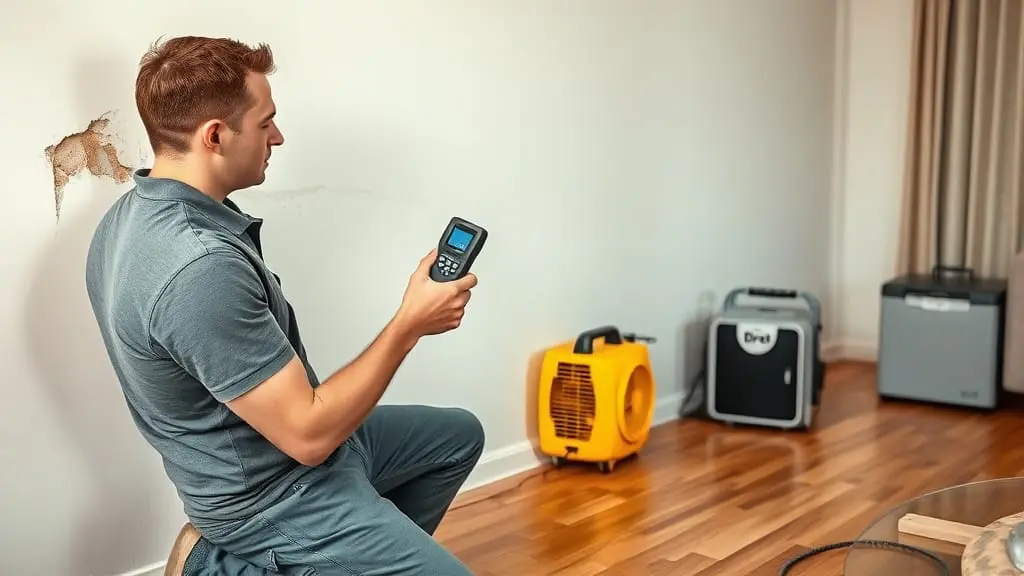
Professional water damage restoration teams deploy several types of equipment working together. Low-grain refrigerant (LGR) dehumidifiers are the workhorses of modern structural drying. They cool incoming air below its dew point, condensing moisture that is then pumped out of the building. A single commercial LGR dehumidifier can remove 15 to 30 gallons of water from the air per day.
High-velocity air movers create directed airflow across wet surfaces, dramatically increasing the evaporation rate. The positioning of air movers is critical — technicians angle them to create a "vortex" pattern that maximizes airflow across all wet surfaces. For a typical Fort Worth home, one air mover for every 10 to 16 linear feet of wall is the standard.
Specialty equipment includes injectidry systems that force dry air into wall cavities through small holes, hardwood floor drying mats that draw moisture from flooring, and air scrubbers with HEPA filters that remove airborne particulates and mold spores during the drying process.
Monitoring and Adjusting the Drying Process
Professional drying is not a set-it-and-forget-it process. Technicians conduct daily monitoring visits using moisture meters (both pin-type and non-invasive) to measure the moisture content of structural materials, thermal hygrometers to measure air temperature and humidity, thermal imaging cameras to detect hidden moisture pockets, and documentation logs that track drying progress over time.
Based on these readings, technicians adjust equipment placement, add or remove dehumidifiers, reposition air movers, and modify the drying environment. This adaptive approach ensures the fastest possible drying while protecting sensitive materials. For example, drying hardwood floors too aggressively can cause cracking, while drying drywall too slowly allows mold to establish.
Drying Goals and Standards
The IICRC S500 Standard for Professional Water Damage Restoration establishes drying goals based on the type of materials and the pre-loss conditions. The goal is to return materials to within normal moisture content ranges for the Fort Worth area — typically 8 to 12 percent for wood framing and less than 1 percent for drywall, as measured by moisture meters. Drying is not considered complete until all affected materials meet these standards, regardless of how long it takes.
Why Professional Drying Matters for Your Fort Worth Home
Inadequate drying is the leading cause of secondary damage after water events. Homes that are not properly dried develop mold, experience wood rot, and suffer ongoing structural issues that may not become apparent for months or years. The cost of professional structural drying is a fraction of the cost of dealing with these long-term consequences.
At 2 Brothers Restoration, our technicians hold IICRC certifications in both Water Restoration and Applied Structural Drying. We bring the science, the equipment, and the expertise to dry your Fort Worth home correctly the first time. Contact us to learn more about our restoration process, or visit our FAQ page for additional details on structural drying timelines and procedures.
Get Priority Response
Step 1 of 3Have an Emergency?
Do not let water damage sit. We are available 24/7 to take your call.
(817) 607-3264