
How Moisture Detection Technology Finds Hidden Water Damage
How Moisture Detection Technology Finds Hidden Water Damage
The most dangerous water damage is the kind you cannot see. A burst pipe that floods a kitchen is obvious. But a slow leak inside a wall cavity, moisture migrating under flooring from a distant source, or condensation accumulating in an attic space can go undetected for weeks or months, silently causing structural deterioration and mold growth.
At 2 Brothers Restoration, moisture detection is the foundation of every project we undertake. Before we place a single piece of drying equipment, we invest significant time in understanding exactly where the water went and how far it traveled. This detective work relies on a suite of advanced technologies that allow us to see through walls, under floors, and into spaces that would otherwise require destructive investigation.
Why Hidden Moisture Is So Dangerous
Water follows gravity and the path of least resistance, but it also wicks through porous materials via capillary action. A single leak can travel along pipes, electrical conduits, and framing members, appearing in rooms far from the original source. We have traced moisture from a second-floor bathroom leak to a first-floor kitchen ceiling on the opposite side of the house. Without proper detection, these hidden moisture pockets become prime locations for mold colonies, wood rot, and structural failure.
Hidden moisture also complicates insurance claims. If your restoration company does not detect and document all affected areas, you may discover additional damage weeks later that your insurance company refuses to cover because it was not documented during the initial assessment.
Infrared Thermal Imaging
Infrared thermal imaging is perhaps the most powerful non-invasive tool in our detection arsenal. Here is how it works:
Every surface emits infrared radiation proportional to its temperature. An infrared camera converts this radiation into a visual image where different temperatures appear as different colors. Wet materials are cooler than dry materials because the evaporation of moisture draws heat away from the surface, a process called evaporative cooling. On a thermal image, a wet wall appears as a distinctly cooler area compared to the surrounding dry wall.
What Infrared Cameras Reveal
- Moisture behind drywall: Wet framing and insulation behind drywall show up as cool patterns that trace the path of water migration, often revealing damage far beyond the visible water line.
- Moisture under flooring: Water trapped beneath tile, laminate, or hardwood creates cool spots visible on the thermal image, even when the floor surface appears completely dry.
- Active leaks: A continuous drip or slow leak produces a distinctive thermal signature that helps us pinpoint the exact source.
- Drying progress: As materials dry, their thermal signature changes. We use thermal imaging throughout the drying process to verify that all areas are responding to our equipment placement.
It is important to note that infrared cameras detect temperature differences, not moisture directly. Other conditions like air drafts, HVAC supply vents, or sun exposure can create temperature patterns that mimic moisture. This is why we never rely on thermal imaging alone. Every anomaly detected by the camera is confirmed with direct moisture measurement using other tools.
Pin-Type Moisture Meters
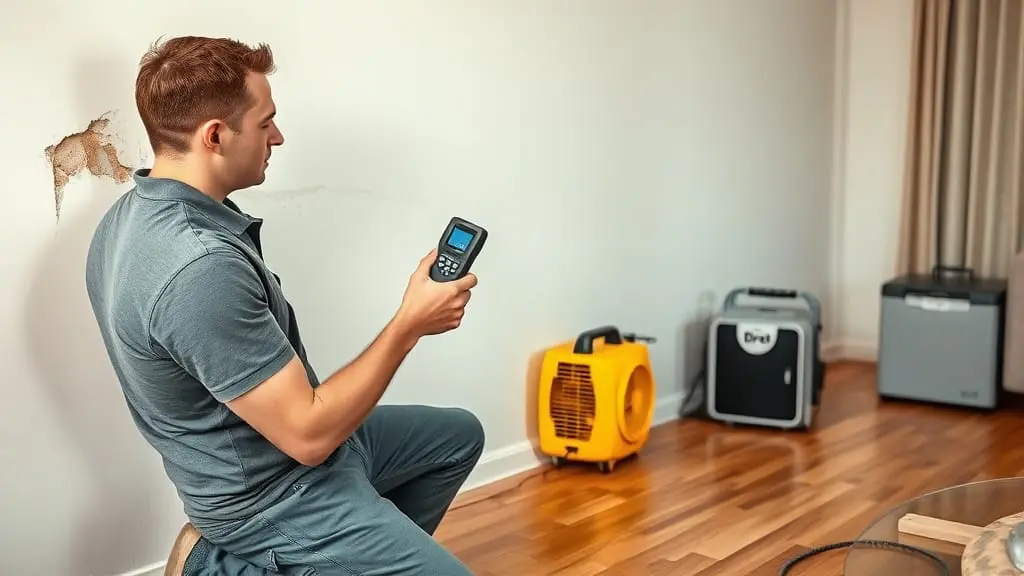
Pin-type moisture meters are our primary tool for quantitative moisture measurement. These instruments have two sharp pins that are pressed into or through the material surface. A small electrical current flows between the pins, and the meter measures the resistance. Since water conducts electricity far better than dry building materials, higher moisture content produces lower resistance and a higher reading on the meter.
Applications and Advantages
- Precise depth readings: By using pins of different lengths or insulated pins, we can measure moisture at specific depths within a material. This tells us whether moisture is concentrated at the surface or has penetrated deep into the substrate.
- Material-specific calibration: Different materials have different normal moisture contents. Our meters can be calibrated for wood, drywall, concrete, and other common building materials, providing readings specific to the material being tested.
- Progress tracking: We take pin meter readings at the same locations daily during the drying process and record them in our drying log. This data objectively demonstrates when materials have reached their dry standard.
- Dry standard comparison: We always measure unaffected materials in the same home to establish a "dry standard" baseline. The affected materials are considered dry when their readings match this baseline.
Pinless (Non-Invasive) Moisture Meters
Pinless moisture meters use electromagnetic radio frequency signals to detect moisture without penetrating the material surface. The meter is simply pressed against the surface and a reading is displayed instantly.
These tools are invaluable for:
- Rapid scanning: Pinless meters allow us to quickly scan large areas of wall or floor to identify the general boundaries of moisture intrusion before drilling down with pin meters for specific readings.
- Finished surfaces: On materials where pin holes would cause visible damage, such as hardwood floors, decorative trim, or painted surfaces, pinless meters provide readings without any impact.
- Initial assessment speed: During the emergency response phase, pinless meters let us map the affected area quickly so we can begin placing extraction and drying equipment without delay.
Thermo-Hygrometers and Psychrometric Analysis
Water damage restoration is fundamentally about controlling the drying environment. Thermo-hygrometers measure temperature and relative humidity simultaneously at various points throughout the drying zone. From these measurements, we calculate critical values like specific humidity, dew point, and grain depression, which tell us how effectively our drying equipment is performing.
If the specific humidity inside the drying zone is not significantly lower than the specific humidity of the air entering the dehumidifiers, our equipment is not extracting moisture efficiently. These readings guide equipment adjustments throughout the project. We may need to add dehumidifiers, reposition air movers, seal off the drying zone from outside air, or adjust temperature settings.
Borescopes for Visual Inspection
Sometimes we need to look inside a wall or ceiling cavity without cutting a large access hole. Borescopes are flexible fiber-optic cameras small enough to fit through a quarter-inch hole. We can insert them into wall cavities, floor joist spaces, and other concealed areas to visually inspect for water staining, mold growth, or structural damage. The images are displayed on a screen and can be photographed for documentation.
Borescope inspection is especially useful when making the decision to perform a flood cut on drywall. By inserting the camera through a small hole, we can see the condition of the framing and insulation behind the drywall without committing to demolition. This information helps us make more accurate and cost-effective decisions about what stays and what goes.
Moisture Detection in Practice: A Real-World Example
Recently, we responded to a home in Fort Worth where the homeowner noticed a damp spot on their first-floor ceiling. Using our thermal imaging camera, we identified a large moisture plume extending several feet from the visible spot. Pin meter readings confirmed saturated drywall on the ceiling and the wall behind it. A borescope inspection through a small ceiling hole revealed active dripping from a corroded pipe fitting in the second-floor bathroom above.
Without our detection equipment, the homeowner might have patched the visible ceiling stain and never addressed the hidden source. Within months, the slow leak would have caused extensive mold growth and structural damage in the concealed joist space.
Why Professional Detection Matters
Consumer-grade moisture meters available at hardware stores can detect surface moisture, but they lack the sensitivity, calibration options, and depth capabilities needed for thorough water damage assessment. More importantly, the equipment is only as good as the person using it. Our IICRC-certified technicians understand building science, know how moisture moves through different construction assemblies, and can interpret readings in context.
If you suspect hidden water damage in your home, whether from a known burst pipe, a storm damage event, or an unexplained musty odor, call 2 Brothers Restoration for a professional moisture assessment. Our technology finds what your eyes cannot see, and early detection saves you thousands in repair costs.
Get Priority Response
Step 1 of 3Have an Emergency?
Do not let water damage sit. We are available 24/7 to take your call.
(817) 607-3264